Dispersion of a nanotube in vortex state#
This notebook will calculate the dispersion relation of a nanotube with 60 nm outer and 40 nm inner diameters, permalloy material parameters. The obtained dispersion(s) must be equivalent to that(those) calculated analytically as well as with micromagnetic simulations published in: Jorge A. Otálora, Ming Yan, Helmut Schultheiss, Riccardo Hertel, and Attila Kákay, Phys. Rev. Lett. 117, 227203 (2016).
First we need to import the TetraX package. The %matplotlib notebook and import matplotlib.pyplot as plt are for plotting the obtained dispersions.
[1]:
import tetrax as tx
%matplotlib notebook
import matplotlib.pyplot as plt
Here, we create a sample with permalloy like material parameters. By default the material parameters are set to those of permalloy. Each sample needs a geometry in the form of a mesh. We create a geometry with tubular cross section, 30nm outer and 20 nm inner radii. To do so, we use the tube_cross_section(r,R,lc,x0,y0) geometry function from the geometries module.
[2]:
sample = tx.create_sample(name="Nanotube_20_30")
sample.Msat = 800e3
sample.Aex = 13e-12
sample.Didmi = 0
mesh = tx.geometries.tube_cross_section(20,30,lc=3)
sample.set_geom(mesh)
Setting geometry and calculating discretized differential operators on mesh.
Done.
The sample parameters, material and mesh, can be listed by typing sample.
[3]:
sample
[3]:
Sample: Nanotube_20_30
| Material parameter | Attribute name | Value |
|---|---|---|
| Saturation magnetization | Msat | 800000.0 A/m |
| Exchange stiffness constant | Aex | 1.3e-11 J/m |
| Gyromagnetic ratio | gamma | 176085964400.0 rad Hz/T |
| Gilbert damping parameter | alpha | 0.01 |
| Unaxial anistropy constant | Ku1 | 0.0 J/m3 |
| Unaxial anistropy angles | k_phi k_theta |
0.0° 0.0° |
| Cubic anistropy constant | Kc1 | 0.0 J/m3 |
| Cubic anistropy axes | v1Kc v2Kc |
(1, 0, 0) (0, 1, 0) |
| Bulk DMI constant | Dbulk | 0.0 J/m2 |
| Interfacial DMI constant | Didmi | 0 J/m2 |
| Mesh parameter | Attribute name | Value |
| Mesh scaling | scale | 1e-09 |
| Number of nodes | nx | 272 |
| Number of boundary nodes | nb | 105 |
Let’s set an initial state and visualize it.
[4]:
sample.mag = tx.vectorfields.helical(sample.xyz, 60, 1)
sample.show()
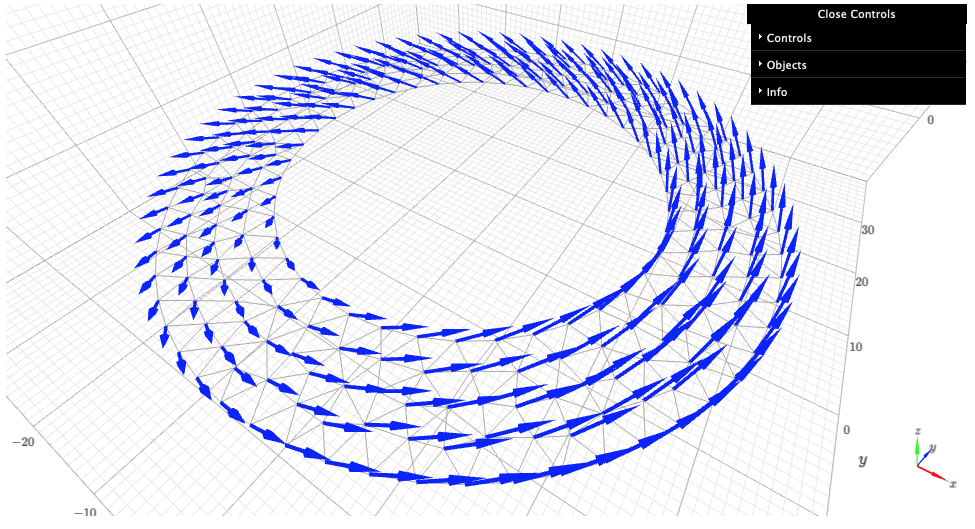
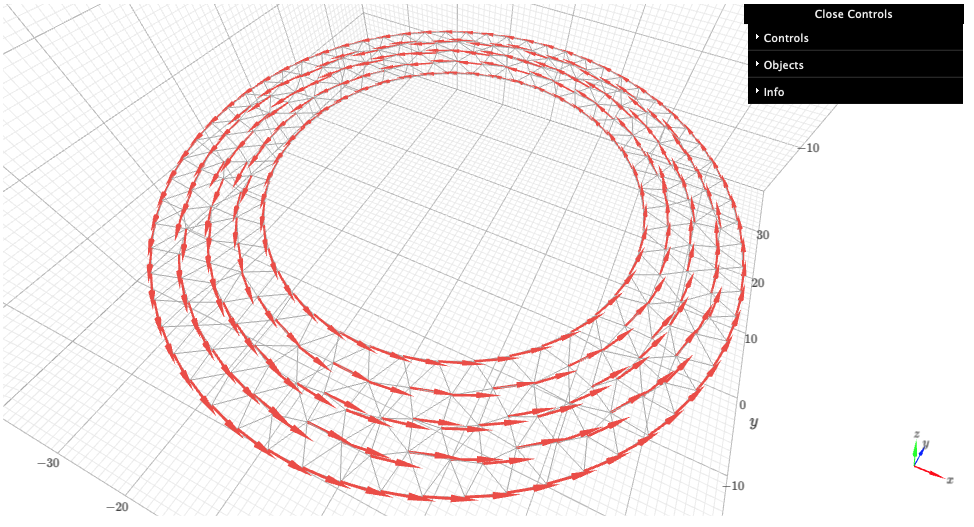
Let’s create an experiment, set a circular field of 80 mT and visualize it. Fields too must be given in SI units.
[5]:
exp = tx.create_experimental_setup(sample)
Bphi = tx.vectorfields.helical(sample.xyz, 90, 1) * 0.08
exp.Bext =  Bphi
exp.show(scale=50)
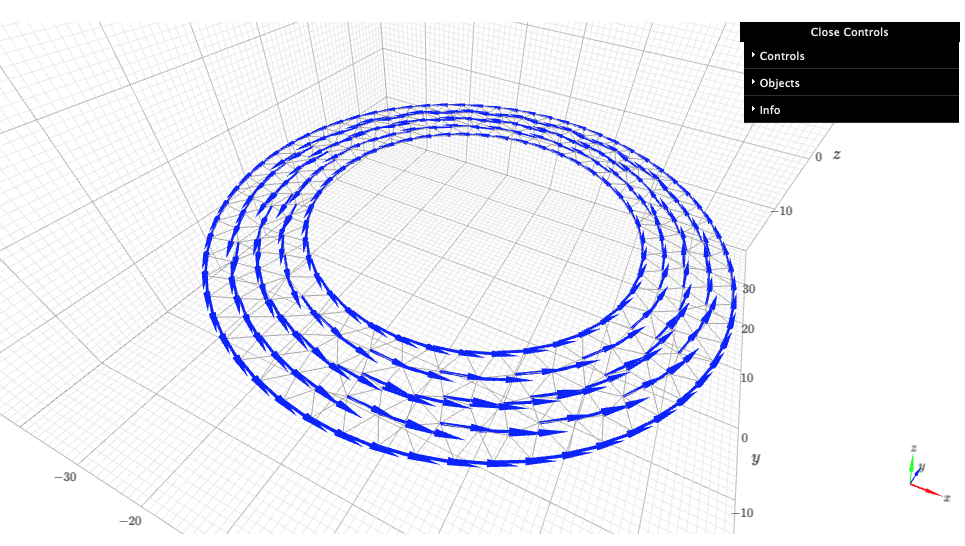
Let’s compute the equilibrium state and visualize it again.
[6]:
exp.relax(tol=1e-13,continue_with_least_squares=True)
sample.show()
Minimizing in using 'L-BFGS-B' (tolerance 1e-13) ...
Current energy length density: -6.727272024843342e-11 J/m  mx = 0.00  my = -0.01  mz = -0.00
Success!
We can now compute the dispersion relation for a set of wave vectors and number of modes (not, the computation of each wavevector k is done parallel. num_cpu=-1 will involve all available CPU cores into the dispersion computation):
[7]:
dispersion = exp.eigenmodes(num_cpus=-1,num_modes=10,kmin=-40e6,kmax=40e6,Nk=81)
100%|██████████| 81/81 [00:46<00:00, 1.73it/s]
Let’s plot the obtained dispersion, the first 5 or any number of modes. Here, we use transparency, thus the colour of the singlet solutions will be lighter compared to the dublets.
[9]:
k_ = dispersion["k (rad/m)"]
plt.figure()
for i in range(9):
    plt.plot(k_*1e-6, dispersion[f"f{i} (GHz)"].values, ls="-", marker="", markersize=1, color="grey", alpha=0.6)
plt.xlabel("Wave vector (rad/µm)")
plt.ylabel("Frequency (GHz)")
plt.show()
